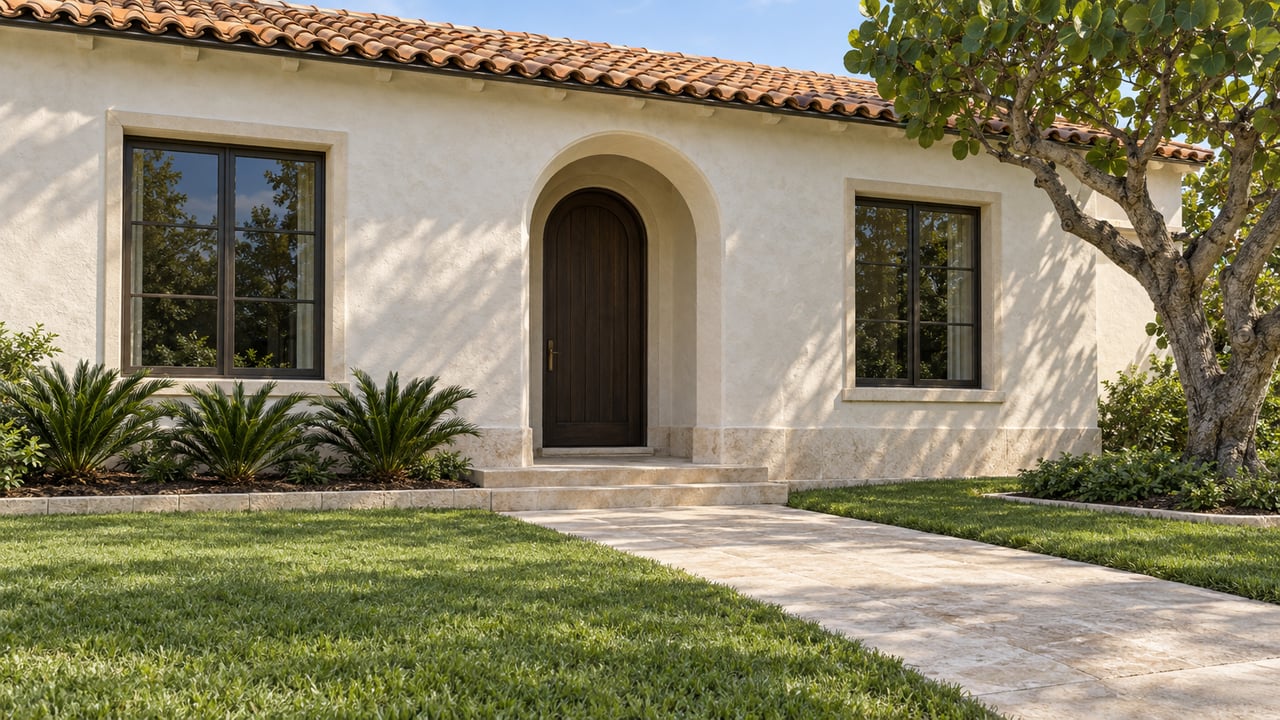
On September 29, 2026, the Coral Gables City Commission adopted Resolution 2026-280. It approved ad valorem tax relief for 720 Madeira Avenue, a single-family home built in early 1937 in the Coral Estates subdivision. The house went onto the Coral Gables Register of Historic Places on December 19, 2024. The renovation that followed has an applicant-estimated cost of $1,166,282, and $1,030,039 of that is work on the historic building. City staff noted they had not verified those figures.
The order of events is designation first, then renovation, then tax relief. Owners often request historic status, and a home that has gone through the process carries obligations that pass to the next owner at closing.
The Covenant a Buyer Inherits
The friction starts with the exemption itself. Under Article 8 of the Coral Gables Zoning Code, the City Commission can exempt 100% of the assessed value of qualifying improvements to a historic property. The exemption covers only taxes levied by the City. Bond taxes and voter-approved levies are excluded. The City's application form describes the relief as applying to the tax increase that comes from the improvements, and only for taxing authorities that participate. It is not a waiver of the whole property tax bill.
Three provisions matter most to a buyer:
- Duration. An exemption runs for ten years and continues "regardless of any change in the authority of the City to grant such exemptions or any changes in ownership of the property."
- The covenant. To qualify, the owner signs a restrictive covenant with the City Commission for the full term. It requires that the property's character and the qualifying improvements be maintained, and it binds "the current property owner, transferees, and their heirs, successors, or assigns."
- The clawback. If the covenant is violated, the property owner owes the difference between the taxes that would have been due and the taxes actually paid in every prior year the covenant was in effect, plus interest.
A buyer who purchases a home with an active exemption takes over the lower City tax line and the maintenance obligation together. The ordinance places repayment on "the property owner," so whoever holds title when a violation occurs is the person the code addresses. A copy of the recorded covenant, the approving resolution and its stated expiration date can be requested before closing. The code requires the resolution to name the owner, the address, the period of the exemption and its expiration date.
Why an Owner Would Volunteer for This
At the September 17, 2026 meeting of the Historic Preservation Board, the board voted 7–0 to designate 314 Cadima Avenue as a local historic landmark. The owner had filed the request himself. The house is a 1925 Mediterranean Revival cottage designed by H. George Fink and built by the team of Lindsay Hopkins and Herbert Nichols in the Coconut Grove Section. At the hearing, the owner said he wanted to add a room without changing much of the house. Staff said the plan would go to the Board of Architects within weeks and then come back to the preservation board for a certificate of appropriateness. The Historic Preservation Association of Coral Gables sent a letter supporting the designation.
Owners request designation because it brings regulatory tools that an undesignated house cannot use. It also adds review, which is the cost.
| Tool | Who qualifies | What it allows | The condition attached |
|---|---|---|---|
| City tax exemption on improvements | Local landmarks, contributing structures in local districts, National Register properties | 100% of the assessed value of qualifying improvements exempt from City taxes for 10 years | Work must meet the Secretary of the Interior's Standards; the covenant binds future owners |
| Zoning variance through the HPB | Designated local landmarks | Relief from code terms where it serves preservation | Granted only together with a Special Certificate of Appropriateness |
| Transfer of development rights | Designated landmarks | Development rights can be certified and transferred | A landmark that transfers its rights cannot be demolished |
| Coral Gables Cottage incentive | Designated, one-story, SFR-zoned homes built before 1940 with frontage of 65 feet or less and at least 12 of 19 listed original features | Additions can align with existing walls down to 2 feet 6 inches from the property line, or take a setback reduction of up to 25%; 48% primary coverage, 58% total; open-space requirement reduced by 10 points | Changes cannot diminish the home's cottage character; a converted garage cannot be used as a rental unit |
The Cottage rules make the strongest case for volunteering. They are written for the small 1920s and 1930s houses that standard setbacks make hardest to expand, and a home has to be designated before any of them apply.
The exemption has its own timing rule. The Part I application has to be filed before construction begins, together with proof of designation and an approved certificate of appropriateness. The City charges a $500 processing fee. Part II is filed after the work is finished. The Historic Preservation Board then makes a recommendation and the City Commission votes. If an owner starts work without filing Part I, those improvements fall outside the exemption.
The program is not limited to modest projects. In 2025 the Commission approved Resolution 2025-336 for 4125 Santa Maria Street, a contributing resource in the Santa Maria Street Historic District. The applicant estimated that project at $6,100,000. As of August 2026, MIAMI REALTORS listed Coral Gables among Miami-Dade's five hottest million-dollar single-family markets. At those values, an exemption on seven-figure improvements is a meaningful line on the City portion of a tax bill.
What the Review Sequence Looks Like on Real Addresses
The extra time comes from the order of review. The City's COA application requires a Board of Architects recommendation before a certificate of appropriateness application can be submitted, and incomplete applications are not scheduled. After that, the code sets two tracks:
- Standard COA. Staff review handles minor exterior work. The Historic Preservation Officer approves or denies within 30 days of a complete application.
- Special COA. Additions, demolition and major exterior remodeling go to the Historic Preservation Board. The board is directed to act within 60 days of a complete application, with public notice at least 10 days before the hearing.
Two cases from the September 17 agenda show the process in practice. At 410 Minorca Avenue, a 1935 local landmark, the board deferred a proposed second-story rear addition in July after motions failed. The architect came back with a flat-roofed connector that separates the old structure from the new one, removed decorative vents from the addition, and changed an archway that repeated the main entry too closely. The board approved the revised plan 7–0 and added a ninth condition asking for further study of openings beside the master bedroom entry.
At 1203 Alhambra Circle, a contributing home in the Alhambra Circle Historic District, the house was permit number 23 in the city, designed in 1922 by Walter DeGarmo. The plan includes a rear addition of about 189 square feet, a detached gazebo of about 270 square feet, and a garage converted to a guest bedroom. The Board of Architects approved it in March. The preservation board approved it in September with 13 conditions. About six months passed between those two approvals for a project that staff described as mostly interior work.
Routine permits run on a much faster track. Coral Gables Magazine reported in October that the City's One Day Permit pilot will be made permanent. It offers one-day approval for routine requests filed by 8 a.m. with fees paid by close of business. Historic review is separate from that track. At the same September meeting, staff warned applicants that fake invoices are circulating that ask for cash or wire transfers. Staff said City invoices come through the City's system and the City never asks for wires.
The Designation Report Doubles as a House History
A buyer can also use the research that comes with a designation. Staff reports presented to the Historic Preservation Board trace a house's alterations over the decades, using permit files, historic photographs and aerial imagery. Where staff could not locate a permit for a given change, the report says so and dates the change from aerial photos instead.
When a home has been designated, or an owner is preparing a designation request, that report can show alterations that do not appear in the permit file.
North Ponce and the Flagler Section Are Next in Line
Designation may come to more of the city. On February 25, 2025, the Commission approved a $98,000 agreement with Miami firm Plusurbia Design for a historic resources survey of North Ponce. The Coral Gables Gazette reported that the roughly 400-page draft covers North Ponce, the city's original apartment district, and the Flagler Section, which became mostly single-family in the 1940s. It documents 556 historic architectural resources. According to the Gazette, the survey is meant to identify areas that could qualify as local or National Register districts. Eligibility would still be decided property by property by City staff.
At the September 17 meeting, staff said the next step is a presentation by the consultant. Staff also said the survey is not a designation report and that any further action depends on direction from the board and the City manager. The board's next meeting is scheduled for October 15, 2026, and its agenda had not been published as of this writing. For a house in the Flagler Section today, the survey is still pending. A buyer should know whether the address appears in it.
Frequently Asked Questions
Does an existing exemption transfer when the home sells? Under Section 8-119, the ten-year term continues regardless of changes in ownership. The covenant binds transferees, and the historic character has to be maintained for the full term.
Does designation relax building code requirements when a historic home is rebuilt? Article 8 does not create a general building code exemption. Its provisions on reconstructing, repairing or rehabilitating designated buildings require compliance with the applicable Florida Building Code and Life Safety Code.
Where can I check whether a property is designated? The City publishes a Coral Gables Register of Historic Places roster. The current version is marked as updated through July 16, 2026.
When a Coral Gables home carries a historic designation, its value depends partly on paperwork the listing doesn't show: the covenant, the approving resolution, the permit record and the review history. Marcelo Steinmander reviews those records with clients before an offer, so the terms of a designation are known before contract. For an owner deciding whether to request designation before selling or renovating, a free home valuation shows where the property stands today.
This article is general information, not legal, tax or financial advice. Consult a qualified professional about your situation.