If you want the energy of urban Miami without relying on your car for every errand, Downtown deserves a serious look. For many buyers, the appeal is clear: you want a condo that feels connected, convenient, and easy to live in day to day. The good news is that Downtown Miami is one of the few South Florida areas where a car-light lifestyle can truly work, but the details matter more than the label on the neighborhood. Let’s dive in.
Why Downtown Miami Works Car-Light
Downtown Miami has a mobility mix that is hard to match in South Florida. You have free internal transit, regional rail connections, trolley service, micromobility options, and highly walkable blocks in the core.
The biggest daily convenience anchor is Metromover. Miami-Dade says it is free, serves 21 stations across Downtown, Brickell, and Omni, and runs every day from 5:30 a.m. to 10 p.m. with frequent service. For many condo owners, that can cover a large share of local trips.
Metrorail adds longer-range utility. It runs from 5 a.m. to midnight, costs $2.25 per ride, reaches downtown and the airport, and connects to Brightline and Tri-Rail. If you want flexibility beyond your immediate neighborhood, that connection matters.
Location Matters More Than Labels
A common mistake is shopping by neighborhood name alone. In practice, the better question is whether your exact building sits near a station entrance, continuous sidewalks, and places you will use every week.
Walk Score identifies Downtown as the most walkable neighborhood in Miami, with a neighborhood score of 91. In the central core, some locations score even higher. For example, 150 SE 3rd Ave has a Walk Score of 99 and Transit Score of 100.
That said, not every nearby address performs the same way. Research examples in Brickell show that some locations remain highly convenient, while others become less practical for a car-light routine. Brickell Avenue at SE 12th Street scores 99, but 2025 Brickell Avenue scores 64, and Brickell Key Drive scores 47.
That gap is important for buyers. A tower may sound close to Downtown or Brickell on paper, but if it sits on an edge location, depends on bridge access, or has weaker transit nearby, your daily routine can feel very different.
Transit Options You Can Actually Use
Metromover for Local Daily Trips
For many buyers, Metromover is the backbone of a car-light lifestyle. It is free, frequent, and designed for movement across Downtown, Brickell, and Omni.
If your building is near stations such as Government Center, Bayfront Park, Knight Center, Brickell, Brickell City Centre, or Tenth Street/Promenade, you may find that a large part of your routine becomes much simpler. Those are the areas where transit connections overlap most efficiently.
Metrorail for Airport and Regional Access
Metrorail matters if you travel often or want more than a neighborhood-only lifestyle. It reaches downtown Miami and the airport, and it also links with Brightline and Tri-Rail.
For some buyers, that can reduce the need to drive to major destinations. It also adds practical value if you split time between neighborhoods or expect frequent visitors.
MiamiCentral as a Key Hub
MiamiCentral is a major piece of the puzzle. Its transportation setup brings together Brightline, Metrorail, Metromover, and Tri-Rail in the same downtown hub.
It also supports day-to-day convenience. MiamiCentral’s published retail includes Publix, Starbucks, Chick-fil-A, and Joe & The Juice, which can make nearby living more functional if you want to keep errands simple.
Free Trolley and Freebee Service
The City of Miami trolley is free and serves Downtown, Brickell, and the Biscayne corridor. The Miami Downtown Development Authority also notes that Freebee can be requested free within the Downtown service area.
These services may help fill short gaps in your routine. If you are comparing two similar condo towers, that extra layer of convenience can make one address more livable than another.
Walkability Is Building-Specific
Walkability is one of Downtown Miami’s biggest strengths, but buyers should not assume every building offers the same experience. The core can feel highly connected, while edge locations may require more planning.
When you tour a condo, look beyond the lobby and amenities. Pay attention to how direct the walk is to transit, whether sidewalks feel continuous, and how easy it is to reach groceries, coffee, pharmacy, or a quick lunch.
In other words, a polished tower alone does not create a car-light lifestyle. The streets immediately outside the building often matter just as much as the finishes upstairs.
Bikes, Scooters, and Short Trips
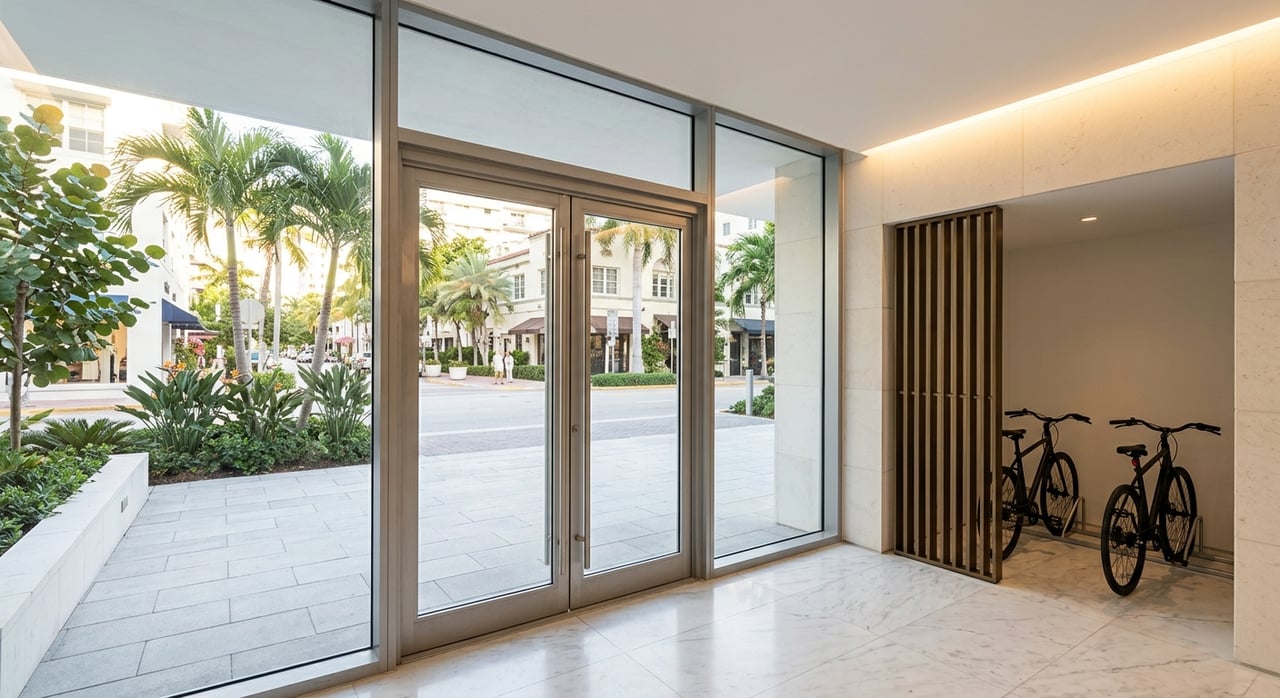
Downtown’s micromobility network is more than a concept. Miami-Dade and the Downtown Development Authority report 6,050 feet of new separated bike lanes and 850 feet of parking-protected bike lanes connecting Government Center, MiamiCentral, Miami-Dade College, and several Metromover stations.
That gives buyers another useful option for short trips. If you like the idea of using a bike or scooter for quick movement around the core, infrastructure is a meaningful part of the story.
The Downtown Development Authority also says the area falls within Pedestrian Priority Zones adopted to improve pedestrian comfort and safety. For someone choosing between urban condo locations, that kind of planning support can be relevant.
Still, buyers should verify the exact street environment outside the building. The City of Miami’s scooter rules prohibit parking that blocks sidewalks, transit facilities, building entryways, and ADA access, which means the immediate frontage and sidewalk design can affect daily convenience.
Cross-Bay and Beach Connections
Another emerging option is water transportation. The Downtown Development Authority includes waterborne transportation as part of the area’s mobility mix.
There is also a free commuter water taxi connecting Miami Beach and Downtown Miami that launched on January 20, 2026. If you expect to move between the mainland and beach side without always driving, that can add another layer of flexibility.
What to Prioritize When Buying
If your goal is to live car-light, your condo search should focus less on broad marketing language and more on practical daily function. A few building-specific questions can quickly tell you whether a property truly fits your lifestyle.
Prioritize Station Proximity
The strongest candidates are often within a short, direct walk of major stations such as Government Center, Bayfront Park, Brickell, Brickell City Centre, Knight Center, or Tenth Street/Promenade. These locations tend to offer the most efficient overlap of rail, Metromover, trolley, and bus access.
A short walk is not the same as a complicated walk. The best building may be the one with the cleanest route, not just the smallest distance on a map.
Check Daily-Need Retail Nearby
For a true car-light routine, transit is only part of the answer. Grocery, pharmacy, and everyday retail can matter just as much.
That is why places near MiamiCentral may stand out for some buyers. Published retail there includes a Publix, which can make weekly errands much easier without adding a car trip.
Think About Occasional Driving
Even car-light buyers may still drive sometimes. If that is part of your plan, parking strategy still deserves attention.
Miami-Dade says there is no Metrorail parking at Brickell or Government Center, though nearby garages and surface lots may exist with pricing that varies. If you expect to keep a car for select trips, confirm how your building handles parking and how practical nearby options really are.
Verify Accessibility and Reliability
If you plan to depend on transit often, check the details that affect consistency. Miami-Dade posts Metromover elevator and escalator status and is upgrading the system.
For buyers who need reliable accessible paths, or simply want fewer daily surprises, this can be an important part of evaluating an address.
Downtown vs. Brickell vs. Edgewater
Many buyers compare these three areas first, and that makes sense. Each can support an urban condo lifestyle, but they do not offer the same level of transit convenience.
Downtown has one of the strongest overall cases for living with minimal car use because of its concentration of stations, free internal transit, and intermodal connections. In the best parts of the core, daily tasks can feel very efficient.
Brickell can also work extremely well, especially in buildings close to the right stations. But the experience is less uniform, and some addresses are notably less convenient than others.
Edgewater can be walkable in some pockets, yet transit access is typically lighter. Research examples in Wynwood-Edgewater show walkability can still be solid, but transit may be more bus-dependent.
For that reason, the smartest comparison is tower by tower. The strongest buildings in Downtown and Brickell can support an almost car-free routine, while edge and island settings can quickly reintroduce friction.
A Smart Touring Checklist
When you visit a condo, use a practical filter instead of relying only on views, amenities, or branding.
Ask yourself:
- How many minutes does it take to walk to the nearest Metromover or Metrorail station?
- Is the route direct and comfortable, or does it involve awkward crossings or gaps in sidewalks?
- Can you reach groceries, coffee, and basic errands on foot?
- Are trolley, Freebee, bike, or scooter options easy to use from this address?
- If you keep a car, what is the real parking setup?
- Does the immediate streetscape support the lifestyle you want every day?
Those questions often reveal more than a glossy brochure ever will.
The Bottom Line for Buyers
Living car-light in Downtown Miami is not just possible. In the right building, it can feel natural and efficient.
The key is choosing with precision. The difference between a great fit and a frustrating one often comes down to one or two blocks, the quality of the walk to transit, and whether your everyday needs are close at hand.
If you are considering a condo in Downtown, Brickell, or Edgewater, building-specific guidance can make the process much clearer. For tailored insight on which towers best match the lifestyle you want, connect with Marcelo Steinmander.
FAQs
Is Downtown Miami good for living without a car?
- Downtown Miami can work well for living with minimal car use because it has free Metromover service, Metrorail access, free trolley service, and strong walkability in the core.
Which Downtown Miami transit option is most useful for daily trips?
- For many residents, Metromover is the most useful daily option because it is free, frequent, and serves 21 stations across Downtown, Brickell, and Omni.
What should buyers check before choosing a car-light condo in Downtown Miami?
- Buyers should check the exact walk to stations, sidewalk continuity, nearby grocery and retail access, and how easy it is to use trolley, bike, scooter, or rail options from the building.
Are all Brickell and Downtown condo locations equally walkable?
- No, convenience varies sharply by exact address, and some edge or island locations are much less practical for a car-light routine than core locations near major stations.
Does MiamiCentral help support a car-light lifestyle in Downtown Miami?
- Yes, MiamiCentral supports a car-light lifestyle because it brings together multiple transit modes and also includes published retail such as Publix and other everyday stops.