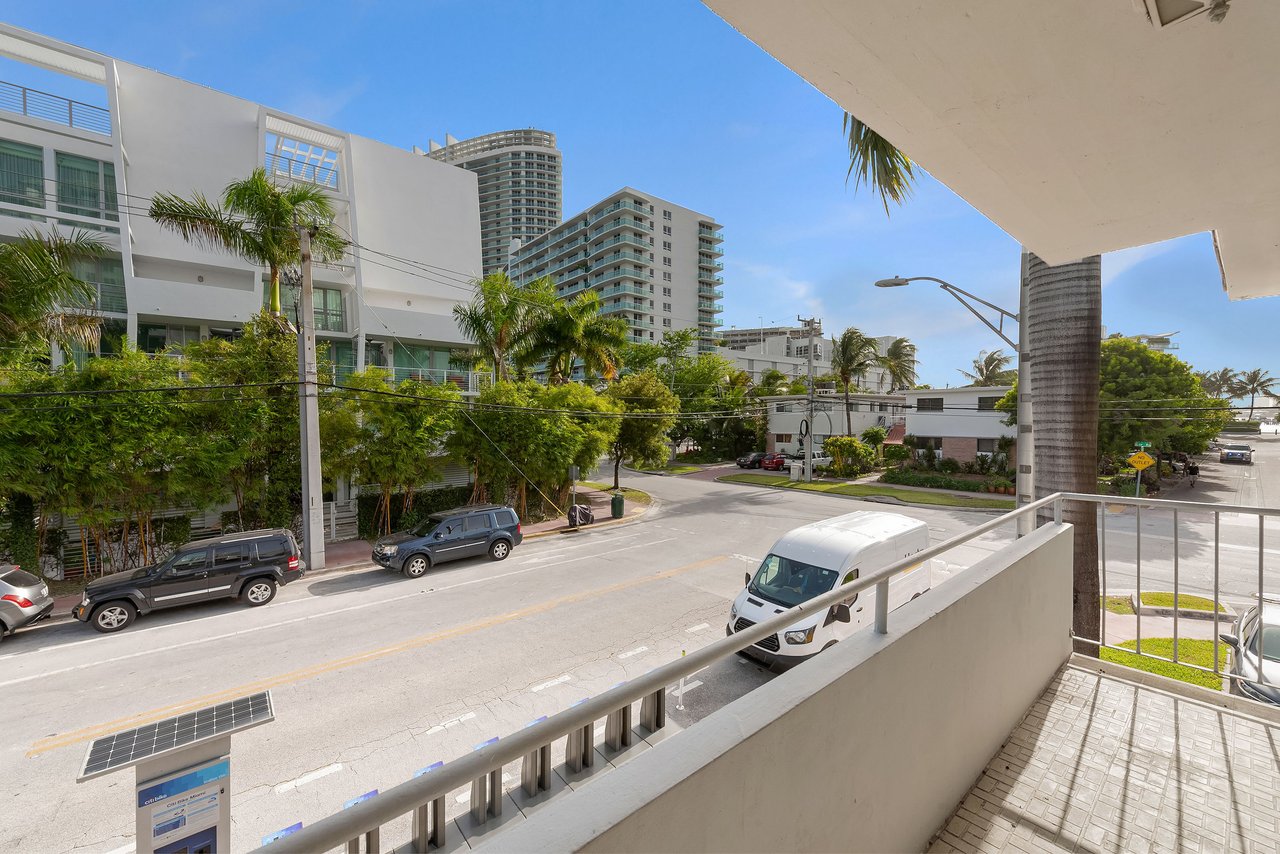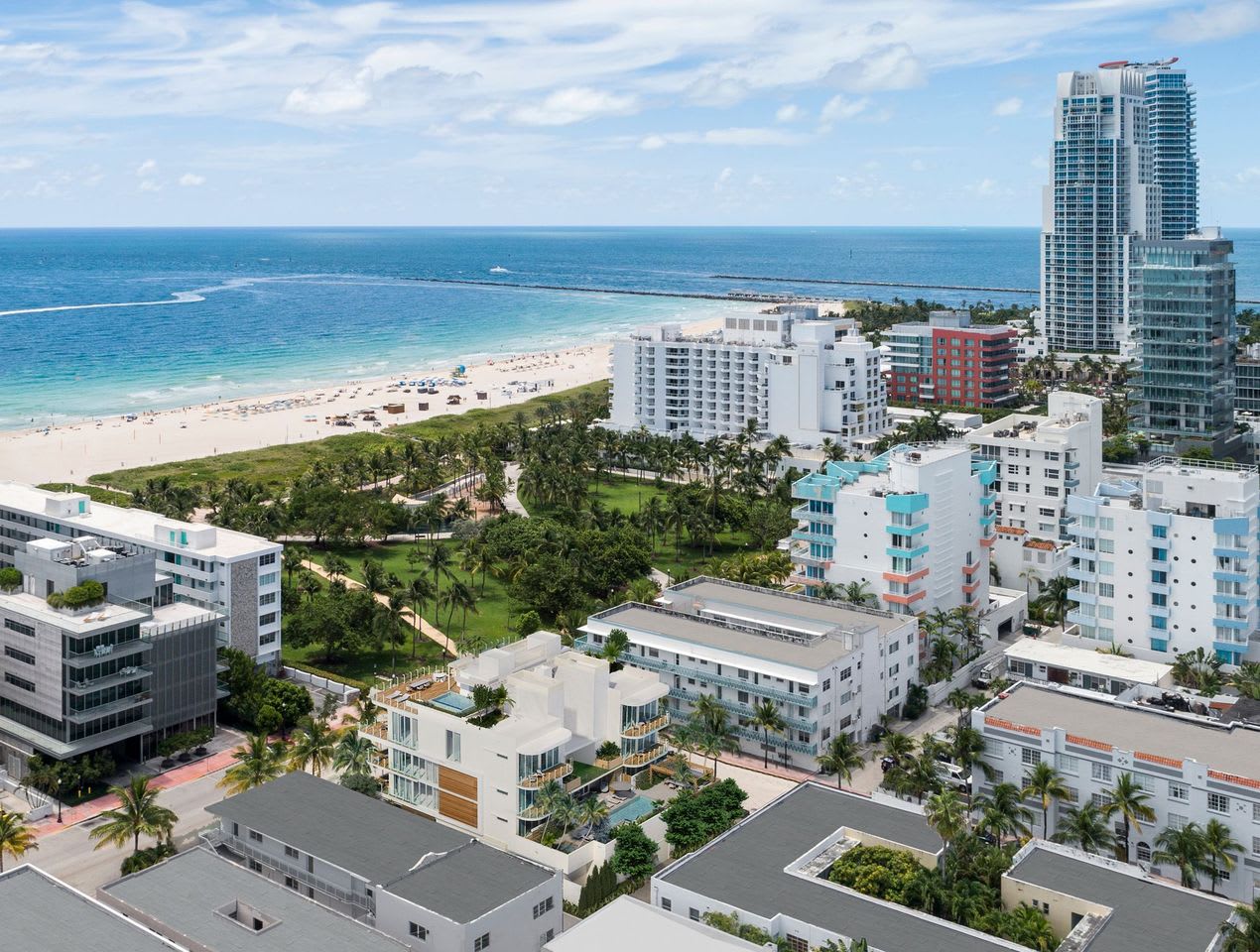
Walk down Collins Avenue on a Tuesday night this month and something feels different, even if you can't immediately place it. The block between 16th and 17th, dark for the better part of five years, has its lights back on. A few blocks south, near 15th, a building that used to disappear behind construction netting now has a name again. Neither of these is a pop-up. Neither is a seasonal experiment. Both are permanent, and that word is doing more work in South Beach right now than any single opening could.
For the last two years, this neighborhood's rhythm has been set by things with an expiration date: a bar that promised to leave in July, a coffee stand that lived out of a cart, a hotel that everyone assumed would eventually get flipped and rebranded again. What's changed in 2026 isn't that new places arrived. It's that the places already here stopped hedging. The two biggest examples are hotels, and the smaller ones are the businesses that share their sidewalks.
The Two Doors That Came Back
The Delano, at 1685 Collins Avenue, had been dark since 2020. Before that it was the kind of address that shaped how people walked this stretch of the beach for a quarter century, ever since Ian Schrager relaunched the 1947 property in 1995 and turned its lobby into the place Madonna and Kate Moss were photographed leaving. When it closed, the foot traffic that used to run between Lincoln Road and the sand didn't disappear. It just rerouted, north toward the Edition and south toward the W. The Delano reopened in May 2026 under Ennismore, with 171 redesigned rooms, four new dining and bar concepts, and the return of Rose Bar under its original name. That single detail matters more than it sounds like it should. Rose Bar was never really about nightlife for the people who live here. It was a fixed point on the mental map, the thing you told a visitor to walk toward when giving directions. Its return doesn't add anything new to the neighborhood so much as it restores a coordinate that had been missing for five years.
By midsummer, the Royal Palm followed. The 1939 oceanfront property on Collins, Marriott's first Tribute Portfolio hotel, finished a renovation valued at more than $100 million and reopened on July 22, 2026, with 404 rooms across its East and West towers and the Lanai bungalow, plus four new food and beverage concepts. Royal Palm's general manager, Royston Brady, called it a cultural return of one of South Beach's defining landmarks, and for once that kind of line from a press release actually tracks with what residents are seeing on the ground. Two of Collins Avenue's most recognizable buildings, both closed for renovation at overlapping points this decade, are now open within the same summer. That's not a marketing campaign. It's a coincidence of construction timelines that happens to have reshaped how this stretch of the beach actually functions for the people who walk it every day.
The Places That Decided to Stop Pretending
The hotels are the headline, but the smaller version of this same story is arguably more telling, because it involves businesses that had every reason to leave and chose not to.
Stormy Monday opened at 820 Alton Road in March 2026 as a five-month residency, taking over the old Macchialina space with an explicit end date of July. James MacInnes, the bar's founder and a veteran of KYU, Kaori, KLAW, and Shiso, built it as a finite project alongside chef Seth Blumenthal and former MLB All-Star Jason Kipnis. It found a following fast, among residents, hospitality workers, and people who wanted a neighborhood bar built for repeat visits rather than a single big night out. Instead of closing in July as planned, it shut briefly for a refresh and reopened August 6 as a permanent fixture, with a new standing bar counter, a refreshed menu, and a standing offer of five dollar Dark & Stormys whenever it rains.
"It became clear pretty quickly that people wanted Stormy Monday to stick around."
Casa Rassi followed a similar arc in miniature. It started as a coffee pop-up, the kind of thing that shows up at a market stall or borrows counter space for a season, and now has a permanent home at 2216 Park Avenue. Its arrival, paired with the newer Suite Habana location a few blocks away, has quietly changed what used to be a genuine gap in the neighborhood: good coffee within walking distance that isn't inside a hotel lobby.
None of this is universal. Medium Cool, the underground vinyl and jazz bar tucked into the Gale Hotel on Collins since 2023, closed its original location on August 22 because the hotel's own plans changed, not because the bar failed. Its founders are still looking for a new Miami address. That's worth naming precisely because it keeps the larger pattern honest. Permanence isn't guaranteed just because a business wants it. But the direction of travel this year, on balance, points toward staying rather than leaving.
Lincoln Road Bought Itself Ten More Years
The clearest evidence that this is a structural shift and not a mood is what's happening one street over, on Lincoln Road. The Lincoln Road Business Improvement District didn't just announce new tenants this year. It signed a new ten-year term extending through 2035, the kind of commitment that only makes sense if the people making it believe the next decade looks different from the last one.
It's easy to forget how recently that wasn't a safe bet. About a decade ago, Lincoln Road carried some of South Florida's highest asking retail rents, peaking near $325 a square foot, right as Brickell, the Design District, and Wynwood were pulling retailers and foot traffic in new directions. The promenade spent the better part of five years losing ground to that competition.
What's reversing that now isn't a single opening. It's a stack of long-horizon capital decisions:
- A $29.4 million city infrastructure project, upgrading Meridian and Drexel avenues with new landscaping, lighting, and drainage, expected to be substantially complete this year
- Developer Michael Comras paying $140 million for eleven storefronts to build what he's calling the NoLi District
- KAR Properties paying $15 million in April for the AllSaints-leased building at 910 Lincoln Road
- A nearly 20,000-square-foot food hall, City Food Hall, taking over the long-vacant former Time Out Market space at 1601 Drexel Avenue
None of that reads like a business betting on a single good season. It reads like people who expect to still be collecting rent checks on Lincoln Road in 2035, which is a different kind of confidence than a restaurant announcing a summer menu.
The One Thing Actually on a Clock
If there's a genuinely temporary window left on the South Beach calendar right now, it's Miami Spice. The city's prix fixe promotion runs through September 30, with participating restaurants including Estiatorio Milos on 1st Street offering three course dinners at a fixed price every night of the week. After the 30th, the deals disappear and menus revert to full price. It's a small thing, but it's also the last piece of this year's South Beach calendar that actually behaves the way pop-ups used to: here for a season, then gone.
Everything else, the Delano's Rose Bar, the Royal Palm's four new dining rooms, Stormy Monday's standing bar, Casa Rassi's espresso machine, Lincoln Road's decade-long lease, is behaving like it plans to be part of your regular week for longer than a summer. That's the actual story here. Not that South Beach got new things this year. It's that South Beach's businesses, hotels, and even its business improvement district all made a coordinated bet, without coordinating with each other, that the neighborhood is worth committing to rather than testing.
If you've lived here through the years when half of Collins Avenue felt like a construction site and your favorite bar always had a countdown clock attached to it, that shift is worth noticing. It changes what a normal Tuesday looks like, and it's the kind of thing you only catch by actually walking the block rather than reading about it from somewhere else.
If you're weighing what any of this means for a property you already own on the island, or you're curious how a specific building or block has held up through this stretch of reopenings, Marcelo Steinmander has spent years tracking South Beach building by building and is glad to talk through what you're seeing on your own street.